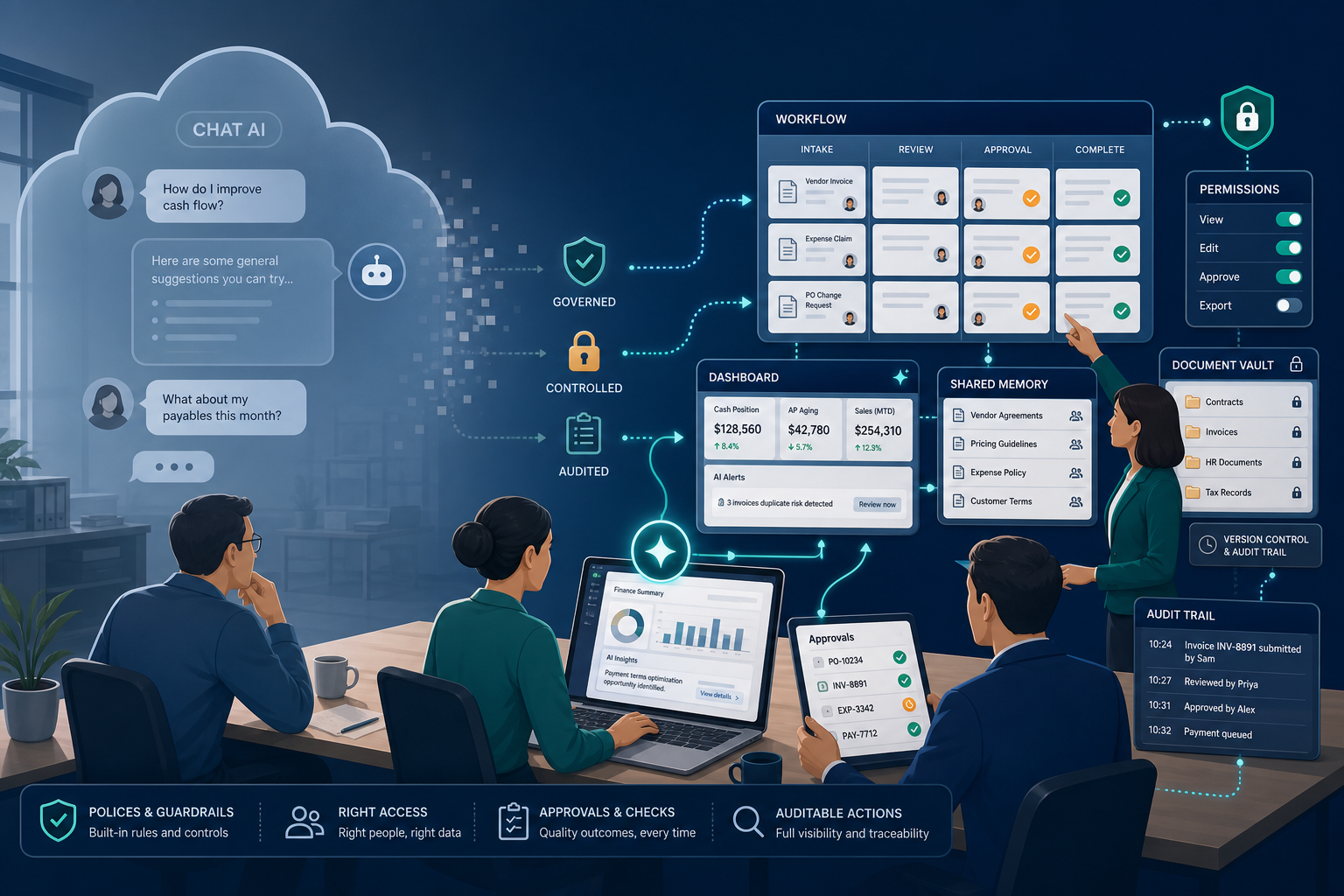
AI adoption is moving beyond chat interfaces and into devices, desktops and workflows. For SMEs, the next buying decision is less about model hype and more about control, governance and where the work actually happens.
The next wave is not just “better chat”
A lot of AI commentary still focuses on the model: who launched what, who is ahead, and which chatbot feels smartest.
But the latest market signals point somewhere more practical.
AI is moving into:
- laptops and devices
- desktop workflows
- developer environments
- enterprise systems with permissions and connectors
- private or local stacks where context stays closer to the user
That shift matters because SMEs do not buy AI to admire the model. They buy it to get work done faster, with less friction and less risk.
Why this matters now
The strongest trend is not a single tool. It is the direction of travel.
Recent market signals point to four things:
- AI is moving onto the device, not just into the browser.
- AI is moving into operational workflows, not just chat.
- Governance and permissions are becoming the real blockers.
- Search, observability and context ownership matter more than model hype.
That changes how SMEs should evaluate tools.
The question is no longer only “what can it do?” It is also:
- where does the data go?
- who controls the workflow?
- can we see what happened?
- can we stop it when needed?
What the market is signalling
1) AI is becoming device-level
Nvidia and Microsoft are both signalling a future where AI is embedded into laptops and local compute, not treated as a separate cloud-only layer.
That is commercially important because it suggests the next buying cycle will be shaped by hardware, local performance and on-device capability as much as model quality.
For SMEs, this means some teams will want faster local assistance for drafting, coding and analysis without shipping every task to the cloud.
2) AI is moving into actual work systems
OpenAI Codex controlling Windows PCs and GitLab’s agentic developer tooling point to a bigger shift: AI is being pulled into real work environments.
That matters because the value is no longer just “generate text”. It is:
- operate software
- move between apps
- follow a task chain
- work with permissions
- complete more of the workflow end to end
This is where SMEs need to become more disciplined, not less.
3) Governance is now the main gating factor
The more capable the tools become, the more important permissions, review gates and auditability become.
That is the part many SMEs underinvest in.
If the tool can act inside systems, then the business must know:
- what it can access
- what it can change
- who approves it
- how to review exceptions
- how to stop it from doing the wrong thing
This is not bureaucracy. It is what makes adoption sustainable.
4) Search and context ownership are becoming strategic
A quieter but important trend is the move towards tools that retain context well.
That includes local autocomplete, document memory, shared memory and local workbenches. Products such as Typeahead, Granite, Second Brain and Wandesk are signs of that shift.
They are not the point of the story on their own. They are evidence that the market is moving towards continuity, portability and control.
What SMEs should do differently
If you are choosing tools now, do not start with “which AI is best?”.
Start with the workflow.
Ask:
- Is this a drafting task, a decision task, or an action task?
- Does the work contain sensitive context or client data?
- Do we need the output to stay local, or can it live in the cloud?
- Do we need auditability and permissions?
- Will this be a one-off experiment, or a repeatable operating routine?
That changes the buying decision.
A practical SME lens
Use cloud AI when you need:
- broad integrations
- fast team rollout
- central governance already built in
- collaborative workflows across departments
Use local or private AI when you need:
- sensitive content handling
- repeated work across apps
- tighter control over where data lives
- persistent context across tools
- fewer vendor dependencies
Most SMEs will end up using both.
Where this leaves the tool market
The useful tools are not the ones with the flashiest demo. They are the ones that help a business do one of three things well:
- keep context
- control access
- complete real work reliably
That is why the current wave matters. It is pushing AI out of the novelty category and into operations.
Bottom line
The next phase of AI adoption is not just smarter chat. It is more embedded, more operational and more governed.
For SMEs, that means the right question is not “what’s the best model?” It is “what part of our work should AI actually touch, and how much control do we need over it?”
If you want help deciding where AI should live in your business, Seemee Technology Services can help you map the right mix of cloud, local and workflow-based tools.
References
- Reuters, “Nvidia launches new chip to bring AI directly to personal computers” — https://www.reuters.com/world/china/nvidia-ceo-kick-off-dominate-computex-gathering-taipei-2026-05-31/
- Reuters, “OpenAI launches Codex app to gain ground in AI coding race” — https://www.reuters.com/business/media-telecom/openai-launches-codex-app-gain-ground-ai-coding-race-2026-02-02/
- GitLab IR, “GitLab Announces the General Availability of GitLab Duo Agent Platform” — https://ir.gitlab.com/news/news-details/2026/GitLab-Announces-the-General-Availability-of-GitLab-Duo-Agent-Platform/default.aspx
- Microsoft Windows Blog, “Introducing a powerful new chapter for Windows PCs, accelerated by NVIDIA RTX Spark” — https://blogs.windows.com/windowsexperience/2026/05/31/introducing-a-powerful-new-chapter-for-windows-pcs-accelerated-by-nvidia-rtx-spark/
- Typeahead official site — https://www.typeahead.ai/
- Granite official site — https://granite.co/
- Second Brain GitHub repo — https://github.com/rahilp/second-brain-cloudflare
- Wandesk official site — https://wandesk.ai/