
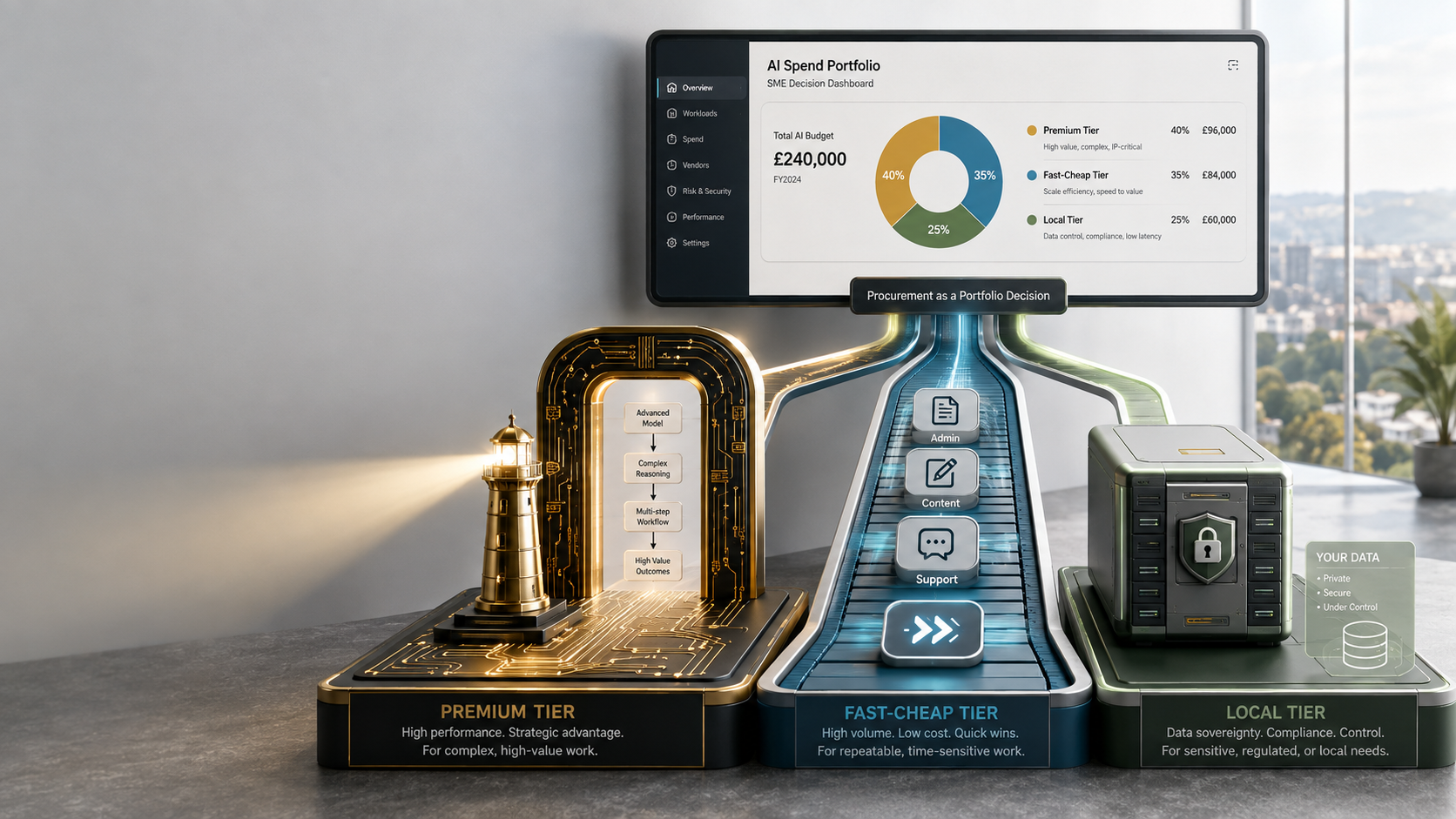
AI spend is splitting into premium, fast-cheap, and local tiers
AI buying used to look like a simple yes-or-no question. Buy the model, try the workflow, see whether it helps.
That frame is already outdated.
For SMEs, AI procurement is now a portfolio decision. Some jobs justify premium models. Some jobs should go to cheaper fast tiers. Some work is starting to make more sense closer to local control. The right answer depends on the task, the risk, and the volume.
The mistake many businesses still make is to compare model price in isolation. That is not a commercial strategy. It is a billing comparison.
Why this matters now
The current release wave makes the new pattern impossible to ignore.
Premium models keep getting stronger. At the same time, lower-cost bulk tools and faster mid-tier options keep getting better. That means SMEs are no longer choosing between “AI” and “no AI”. They are choosing how much to spend on which class of work.
That is a very different buying problem.
If one provider gives you a flagship option for difficult work and another gives you a cheaper tier for high-volume routine tasks, the decision is no longer about brand loyalty. It is about routing.
The smart question is not, “Which model is best?”
It is, “Which model is best for this job?”
The three tiers SMEs should think in
1. Premium tier
Use premium models for work where failure is costly.
That usually means:
- strategic reasoning
- sensitive client-facing work
- complex decision support
- nuanced escalation handling
- anything where a wrong answer creates real commercial or reputational damage
The premium tier is worth paying for when the output matters more than the token bill.
2. Fast-cheap tier
Use cheaper fast models for the routine work that fills the day.
That usually means:
- admin drafting
- customer service triage
- first-pass content
- summaries
- rewrites
- variation generation
This is where most SME AI waste happens. Teams send routine work to the most expensive tier simply because it is the default.
That is convenient, but it is rarely efficient.
3. Local or closer-to-local tier
Use local or near-local approaches when control, repetition, or predictable cost matters more than convenience.
That usually means:
- repeated internal workflows
- sensitive data handling
- tightly bounded tasks
- cases where dependence on a single vendor is becoming a problem
Local is not automatically better. It can reduce spend and improve control, but it also adds maintenance, support, updates, and operating burden.
If the team cannot own that burden properly, “local” becomes hidden complexity rather than savings.
The rule SMEs should actually use
Route by risk, not by habit.
Before you send a task to a premium model, ask four things:
- How bad is a wrong answer?
- How often does this task run?
- How easy is the output to verify?
- What data or customer impact is involved?
If the task is low risk, high volume, and easy to check, premium spend is probably waste.
If the task is sensitive, customer-facing, or hard to reverse, premium may be justified.
That is the whole decision in plain English.
Where the tiers usually fit
Admin
Admin work should usually start in the fast-cheap tier.
Only move to premium when the communication is important, delicate, or likely to create downstream confusion if it is handled badly.
Content
Content is the easiest place to waste money.
Use fast-cheap models for:
- first drafts
- repurposing
- rewriting
- content variants
Use premium models for:
- positioning
- high-judgement thought leadership
- sensitive or commercially strategic messaging
Customer service
Customer service should also be tiered.
Fast-cheap models are often good enough for:
- triage
- standard replies
- case summaries
- internal handoff notes
Premium models belong in escalations, unusual cases, or conversations where tone and accuracy matter more than speed.
The hidden costs people forget
Token spend is only one part of the bill.
SMEs also need to factor in:
- review time
- rework from weak output
- orchestration overhead
- workflow maintenance
- vendor lock-in
- switching friction later
A cheaper model that creates more cleanup is not actually cheaper.
Likewise, a premium model that saves review time may be worth the money if it reduces the number of bad outputs entering the business.
That is why the cheapest line item is not always the cheapest operating choice.
The buying mistake to avoid
There are three common errors.
First, comparing model price without comparing workflow cost.
Second, assuming the most capable model should be the default for everything.
Third, assuming cheaper is always better.
None of those are serious commercial decisions.
The better question is:
What is the cheapest model that still meets the requirement for this task?
That question forces the business to think about quality, risk, frequency, and rework instead of chasing the biggest model or the lowest invoice.
A simple SME decision rule
Use this as a working rule:
- premium for high-stakes, low-volume, hard-to-fix work
- fast-cheap for routine, repetitive, easy-to-check work
- local or closer-to-local for repeated work where control and predictable cost matter
That rule is simple enough for owner-managers and ops teams to use without turning procurement into a research project.
It also creates a cleaner buying conversation.
Instead of asking whether the business should “buy AI”, ask whether this workflow belongs in the premium, fast-cheap, or local tier.
Bottom line
AI procurement is becoming a portfolio decision.
SMEs that route work by tier will spend less, waste less, and keep premium models reserved for the jobs that genuinely justify them.
The goal is not to buy the cheapest model.
The goal is to stop paying premium rates for routine work.
References
- OpenAI GPT-6 Astra API docs: https://developers.openai.com/api/docs/models/gpt-6-astra
- Anthropic Sonnet 5 release notes: https://docs.anthropic.com/en/docs/about-claude/models/whats-new-sonnet-5
- Google Nano Banana 2 Lite and Gemini Omni Flash announcement: https://cloud.google.com/blog/products/ai-machine-learning/nano-banana-2-lite-and-gemini-omni-flash-available
- Google Agent Platform pricing: https://cloud.google.com/gemini-enterprise-agent-platform/generative-ai/pricing