
Before You Let an AI Agent Touch Client Data, Put These Controls in Place
AI agents are moving from chat into real business workflows, which makes governance a commercial issue, not just a technical one. Before you let an agent touch client data, define ownership, access, approvals, logging, and stop conditions.
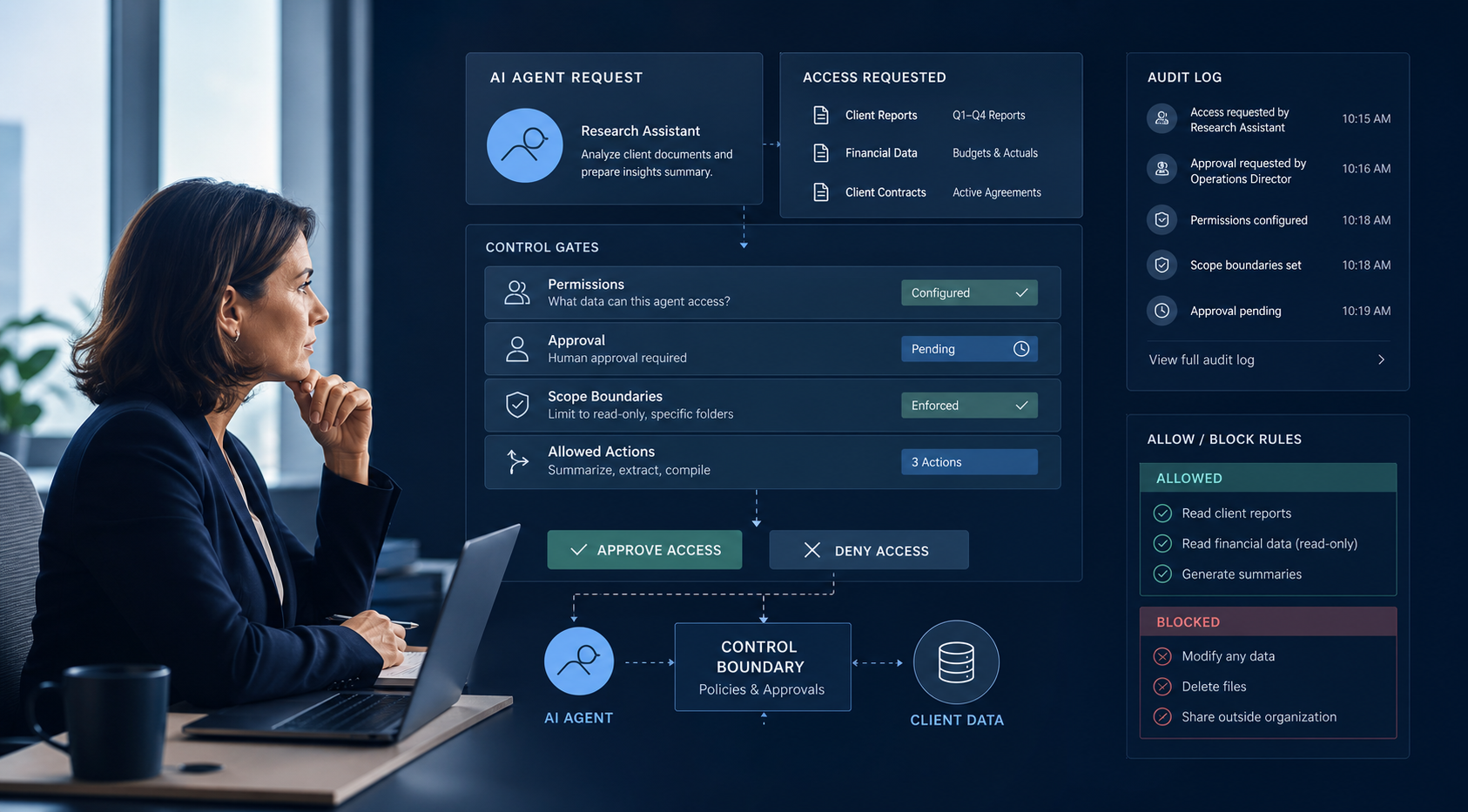
Before You Let an AI Agent Touch Client Data, Put These Controls in Place
Before You Let an AI Agent Touch Client Data, Put These Controls in Place
Most businesses are still asking the wrong question about AI agents.
The weak question is: “What can it do?”
The stronger question is: “Who owns it, what can it access, what must it never do, and who approves the risky stuff?”
That matters because agents are no longer just answering questions in a chat box. They are starting to sit inside actual workflows, connect to systems, move between tools, and act on data. Once that happens, the issue is not novelty. It is control.
For operations leaders, finance decision-makers, and cautious directors, this is the point where AI stops being a productivity toy and becomes an operating risk. It is also where good controls can prevent rework, approval delays, and avoidable exceptions.
If you want the upside without creating a mess, you need a proper control model before the agent touches client data.
The business goal is straightforward: reduce manual effort without increasing error rate, exception handling, or approval drag.
1. Treat the agent like a worker, not a toy
The fastest way to lose control is to let an agent live as a vague feature inside a vendor account.
Every agent needs a defined role:
- a named owner who is accountable for what it does
- a sponsor who approves the use case and permissions
- an operator who uses it day to day
- an approver who signs off sensitive actions
That structure sounds simple, but it is the difference between managed automation and shadow automation.
If nobody can answer who owns the agent, who can change it, and who is responsible if it makes the wrong move, the business is not ready to use it on sensitive data.
Microsoft has now made this shift explicit. Microsoft Entra Agent ID is designed to bring identity, access protection, governance, and compliance into the agent layer itself. That is a strong signal that agent identity is becoming a first-class control point, not an afterthought.
2. Lock the access boundary before the agent sees any data
The most important control is not a policy document. It is access.
Before the agent is connected to anything useful, decide the minimum data and systems it genuinely needs.
In plain English:
- give it read access only where possible
- do not give it write access unless you can justify it
- do not let it inherit broad permissions just because that is easier
- keep payroll, payments, client records, and admin controls out of scope by default
For SMEs, a sensible pattern is:
- a finance support agent can draft reconciliations, but not submit payments
- an operations agent can prepare task updates, but not close exceptions
- a client service agent can draft replies, but not send them without review
That is least privilege in business terms.
Microsoft Security has been saying the same thing in its 2026 guidance on agent security and governance: agents should be treated with the same seriousness as employees or service accounts, with least privilege, explicit verification, and strong observability.
3. Decide where the human approval gate sits
If an agent can take an action that is embarrassing, expensive, or hard to reverse, a human should approve it.
That sounds obvious. In practice, many teams forget to make the approval point explicit.
You need a clear rule for:
- external messages
- financial changes
- data deletion
- permission changes
- client-impacting updates
- anything that could create legal, commercial, or reputational damage
A good SME rule is simple:
If the action would be awkward to explain to a client, accountant, regulator, or director, it does not happen automatically.
That keeps the useful speed, but removes the reckless speed.
4. Log the agent’s actions in a way humans can actually review
Logging is useless if nobody can make sense of it.
You do not need a giant observability project to get value. You need a log that can answer five questions:
- what happened
- when it happened
- which agent did it
- which system or data it touched
- who approved it
That is enough to create a reviewable trail.
For most SMEs, the right cadence is:
- daily review for high-risk workflows
- weekly review for routine operational agents
- monthly access review for permissions
If the workflow is new, track a short pilot set of measures:
- manual interventions
- approval turnaround time
- error or rework rate
- exceptions raised
Those measures show whether the agent is improving the process or simply moving work around.
The point is not to stare at logs all day. The point is to catch exceptions early and prove that the automation is being managed.
Microsoft’s own framing is useful here: observability, governance, and security are now the foundation for agent deployments, because the risk is not just model output quality. It is agent behaviour inside real workflows.
5. Use current vendor and framework signals as evidence, not decoration
This is not a future problem.
Microsoft’s Entra Agent ID work shows where enterprise control is going:
- agent identities are becoming a distinct security object
- access reviews and sponsor accountability are part of the model
- agent activity should be auditable
Microsoft Security’s broader agent guidance also makes the same case: if agents are scaling into finance, service, and product workflows, then visibility and governance become commercial necessities.
And on the risk side, the OWASP Top 10 for Agentic Applications is a useful reminder that the attack surface is not theoretical. Once an agent can take actions, connect tools, or chain tasks, you need to think about prompt injection, tool misuse, data exposure, escalation paths, and unsafe delegation.
That is the real shift. Governance is no longer a compliance appendix. It is what makes the business able to use the tool safely.
For finance leaders, the control model also has to justify spend. If the permissions, review effort, and exception handling outweigh the benefit, keep the use case in pilot until the process is cleaner.
6. A practical control checklist for SMEs
If you want a simple starting point, use this checklist before an agent touches client data:
- Named owner
- Named sponsor
- Clear purpose statement
- Approved data scope
- Blocked actions list
- Human approval gates for sensitive actions
- Logging and review process
- Access review frequency
- Incident stop procedure
- Change control for permissions and prompts
If one of those items is missing, the agent is not ready for production use.
That is not anti-AI. It is how you avoid turning useful automation into unmanaged risk.
7. What not to do
There are a few common mistakes worth calling out directly.
Do not use one shared agent account across a team.
Do not let the agent inherit broad access because someone wants faster setup.
Do not rely on one-time approval and assume the workflow stays safe forever.
Do not treat vendor defaults as a governance strategy.
Do not make this a separate “security project” that has no connection to how work actually gets done.
The control model needs to sit inside the workflow, not beside it.
8. The commercial point
The businesses that will get value from agents first are not the ones that move fastest with no guardrails.
They are the ones that define the controls early, so they can safely delegate more work later.
That is the commercial advantage.
If you know who owns the agent, what it can access, what it must never do, and when a human must step in, you can scale use cases with far less friction.
If you do not know those things, every new use case becomes a new risk debate.
That is why governance is now a growth issue, not just a security issue.
Bottom line
AI agents are moving into real operational workflows. The question for SMEs is no longer whether they are useful. It is whether the business has enough control to use them safely.
Before you let an AI agent touch client data, define the owner, lock the access, set the approval gates, and make the logging reviewable.
Do that properly and you get useful automation without losing control.
Skip it, and you are scaling risk faster than value.
If you want help putting those controls around AI agents in your business, Seemee Technology Services can help you design a practical governance model, review the access boundary, and decide which workflows are safe to automate first.
References
- Microsoft Learn, Microsoft Entra Agent ID: https://learn.microsoft.com/en-us/entra/agent-id/
- Microsoft Learn, What is Microsoft Entra Agent ID?: https://learn.microsoft.com/en-us/entra/agent-id/what-is-microsoft-entra-agent-id
- Microsoft Security Blog, “80% of Fortune 500 use active AI Agents: Observability, governance, and security shape the new frontier”: https://www.microsoft.com/en-us/security/blog/2026/02/10/80-of-fortune-500-use-active-ai-agents-observability-governance-and-security-shape-the-new-frontier/
- Microsoft Security Blog, “Observability for AI Systems: Strengthening visibility for proactive risk detection”: https://www.microsoft.com/en-us/security/blog/2026/03/18/observability-ai-systems-strengthening-visibility-proactive-risk-detection/
- OWASP Top 10 for Agentic Applications: https://genai.owasp.org/2025/12/09/owasp-top-10-for-agentic-applications-the-benchmark-for-agentic-security-in-the-age-of-autonomous-ai/