
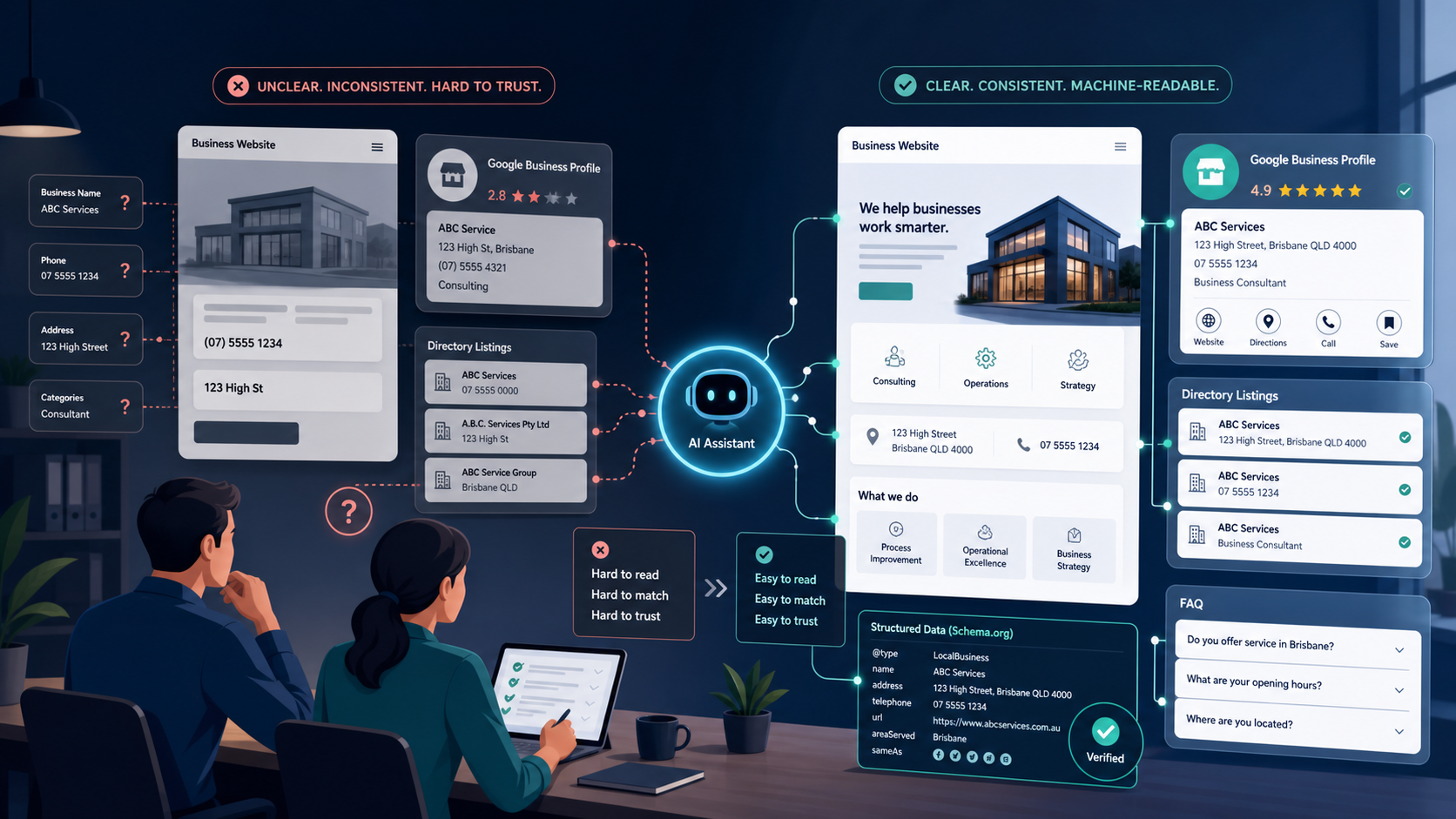
Can AI assistants actually find your business? The SME machine-readable content checklist\n\nAI assistants do not find businesses the same way people do. They do not admire your brand copy first and then decide what you mean. They look for signals they can extract, compare, and trust.\n\nThat means a good-looking website is not enough on its own. If your business details are vague, inconsistent, or buried in marketing language, a machine may struggle to classify what you do, where you operate, and whether you are worth surfacing.\n\nFor SME owners, that turns into a practical problem very quickly: missed enquiries, slower response times, and more admin time spent clarifying basic questions before anyone can move a lead forward.\n\n## What machine-readable actually means\n\nMachine-readable content is content that a system can understand without guessing.\n\nIn plain terms, it answers the basic questions clearly:\n- What does this business do?\n- Who is it for?\n- Where does it operate?\n- How can it be contacted?\n- What proof says it is real and relevant?\n\nThat sounds simple, but many SME sites still make machines work too hard. The homepage says one thing, the service pages say another, the Google Business Profile uses a slightly different name, and the directory listings drift over time. A human can usually make sense of that. A system may not.\n\nGoogle has been explicit that structured data helps it understand content, and its local business guidance repeatedly stresses complete and accurate business information. The lesson is straightforward: if you want to be found, make the business easier to parse.\n\n## How AI assistants decide what to surface\n\nAI assistants are increasingly behaving like synthesis engines rather than simple keyword matchers. They pull from multiple signals at once:\n- page structure\n- business schema\n- service descriptions\n- contact details\n- location data\n- reviews\n- directory listings\n- FAQs and supporting content\n\nIf those signals reinforce each other, the business becomes easier to recommend. If they conflict, the model has to choose which version to trust.\n\nThis is why the problem is not just SEO in the old sense. It is entity clarity.\n\nA business with strong machine-readable signals is easier to classify as a real provider of a real service in a real location. A business with weak signals looks more like generic content.\n\n## The SME machine-readable content checklist\n\nUse this as a practical audit, not a theory exercise.\n\n### 1) Make the business identity obvious\n\nThe homepage should clearly state:\n- the business name\n- the main service category\n- the location or service area\n- the primary audience\n- the main call to action\n\nIf someone lands on the page and still cannot tell what the business does, the machine is probably not getting a clean signal either.\n\n### 2) Keep name, address, and phone consistent\n\nThe business name, address, and phone number should match across:\n- the website\n- Google Business Profile\n- directories\n- social profiles\n- invoices and public documents where relevant\n\nInconsistency creates friction. At best, it wastes time. At worst, it reduces trust and creates missed enquiries.\n\n### 3) Use specific service pages, not generic blurbs\n\nA page called “Services” is not enough if it contains three vague paragraphs and a contact form.\n\nEach core service page should answer:\n- what the service is\n- who it is for\n- what problem it solves\n- where it applies\n- how the business delivers it\n\nSpecific service pages are easier for systems to classify and easier for buyers to trust.\n\n### 4) Write FAQs in plain language\n\nFAQ content is one of the most useful machine-readable assets on a site because it maps directly to natural customer questions.\n\nGood FAQ content should cover:\n- pricing or pricing approach\n- location or service area\n- lead times\n- onboarding or process\n- constraints or exclusions\n\nKeep the language plain. Avoid slogans. Avoid cleverness. The goal is clarity.\n\n### 5) Make headings descriptive\n\nHeadings should describe the section, not decorate it.\n\n“What We Do” is weaker than “IT Support for Small Offices in West London.”\n\nMachines use headings as part of the content structure. So do people scanning quickly. If the heading is clear, both benefit.\n\n### 6) Add supporting context to images, PDFs, and downloads\n\nA lot of SME content disappears into files that look attractive to humans but are weak for machines.\n\nIf you use:\n- brochures\n- price lists\n- case studies\n- menus\n- downloadable guides\n\nmake sure they have surrounding text, file names that make sense, and enough context on the page to explain what they are.\n\nIf a key point only exists in an image or a PDF, you are making the system work harder than it should.\n\n### 7) Keep reviews and profiles aligned with the website\n\nReview profiles, directory listings, LinkedIn pages, and business bios should all reinforce the same story.\n\nIf the website says you specialise in local accounting for contractors but your profile says general finance support, the signal weakens.\n\nThat does not mean every profile needs identical copy. It means the commercial identity must stay consistent.\n\n### 8) Use structured data where it genuinely helps\n\nSchema markup does not fix a messy business. It helps a clear business become more machine-readable.\n\nFor many SMEs, the most useful types are:\n- LocalBusiness\n- Service\n- FAQPage\n- Organization\n\nThe point is not to decorate the website with technical tags. The point is to make the site easier for systems to understand and verify.\n\n## Where SMEs usually fail this test\n\nMost businesses do not fail because they lack content. They fail because the content is hard to trust.\n\nCommon failure points include:\n- one business name on the website and another in directories\n- service pages that are too thin to classify\n- pages written like brochures rather than reference points\n- heavy jargon that hides the actual offer\n- no clear service area or location clues\n- outdated phone numbers or opening hours\n- PDFs doing too much of the explanation work\n\nThe operational cost is not abstract. It shows up as rework, slower response times, more time spent clarifying basic questions, and more leads arriving with the wrong expectation.\n\nIf your team keeps having to interpret enquiries before they can respond properly, the problem is not only sales. It is content structure.\n\n## Quick self-audit\n\nAsk these questions honestly:\n\n1. Can a stranger tell what we do in 10 seconds?\n2. Could an assistant summarise our core services without guessing?\n3. Do the website, Google profile, and social bios tell the same story?\n4. Are our service pages specific enough to answer buying intent?\n5. Are the contact details, location, and service area obvious everywhere they should be?\n6. Is one person accountable for keeping the public business information consistent?\n\nIf you answered no to more than one of those, do not start with advanced AI search tactics. Fix the basics first.\n\n## What to fix first\n\nThe fastest improvement usually comes from the highest-traffic pages and profiles, not from a full site rebuild.\n\nStart here:\n- homepage\n- core service pages\n- contact page\n- Google Business Profile\n- FAQ content\n- business schema where appropriate\n\nFix naming consistency before you produce more content. A larger amount of unclear content does not improve machine readability. It just creates more noise.\n\nThe priority order matters:\n1. clean up identity\n2. make services specific\n3. align profiles and reviews\n4. add structured data\n5. expand supporting content\n\nThat sequence gives you better returns than jumping straight to technical markup.\n\n## Bottom line\n\nAI assistants are not magic search engines. They are systems that reward clarity, consistency, and verifiable signals.\n\nIf your business is easy to understand, easy to classify, and easy to verify, it becomes much easier for machines to surface it. If your content is vague or contradictory, the business may be doing good work in the real world while remaining oddly invisible online.\n\nFor SMEs, the practical answer is not to create more content for its own sake. It is to make the business more machine-readable where it matters most.\n\nThe best way to judge progress is with a baseline and a review cycle. Track whether enquiries are becoming clearer, whether time spent clarifying basics is falling, and whether the business details stay consistent across the main public surfaces.\n\nIf you want help turning your website and business profiles into a clearer, more trustworthy discovery layer, Seemee Technology Services can help you map the gaps and fix the highest-value pages first.\n\n## References\n1. Google Search Central, “Intro to structured data” - https://developers.google.com/search/docs/appearance/structured-data/intro-structured-data\n2. Google Search Central, “Top ways to ensure your content performs well in Google’s AI search” - https://developers.google.com/search/blog/2025/05/succeeding-in-ai-search\n3. Google Business Profile Help, “Guidelines for representing your business on Google” - https://support.google.com/business/answer/3038177?hl=en\n4. Google Business Profile Help, “Tips to improve your local ranking on Google” - https://support.google.com/business/answer/7091?hl=en\n5. McKinsey, “New front door to the internet: Winning in the age of AI search” - https://www.mckinsey.com/capabilities/growth-marketing-and-sales/our-insights/new-front-door-to-the-internet-winning-in-the-age-of-ai-search\n6. BrightLocal, “Local Consumer Review Survey 2025” - https://www.brightlocal.com/research/local-consumer-review-survey-2025/
Check your machine-readable content
Review the homepage, service pages, Google profile, and structured data first.