
Can you audit the AI's work? A simple SME observability model for workflow assistants
A practical SME model for making AI-assisted workflow work visible, measurable and reviewable through a simple register and weekly operating review.
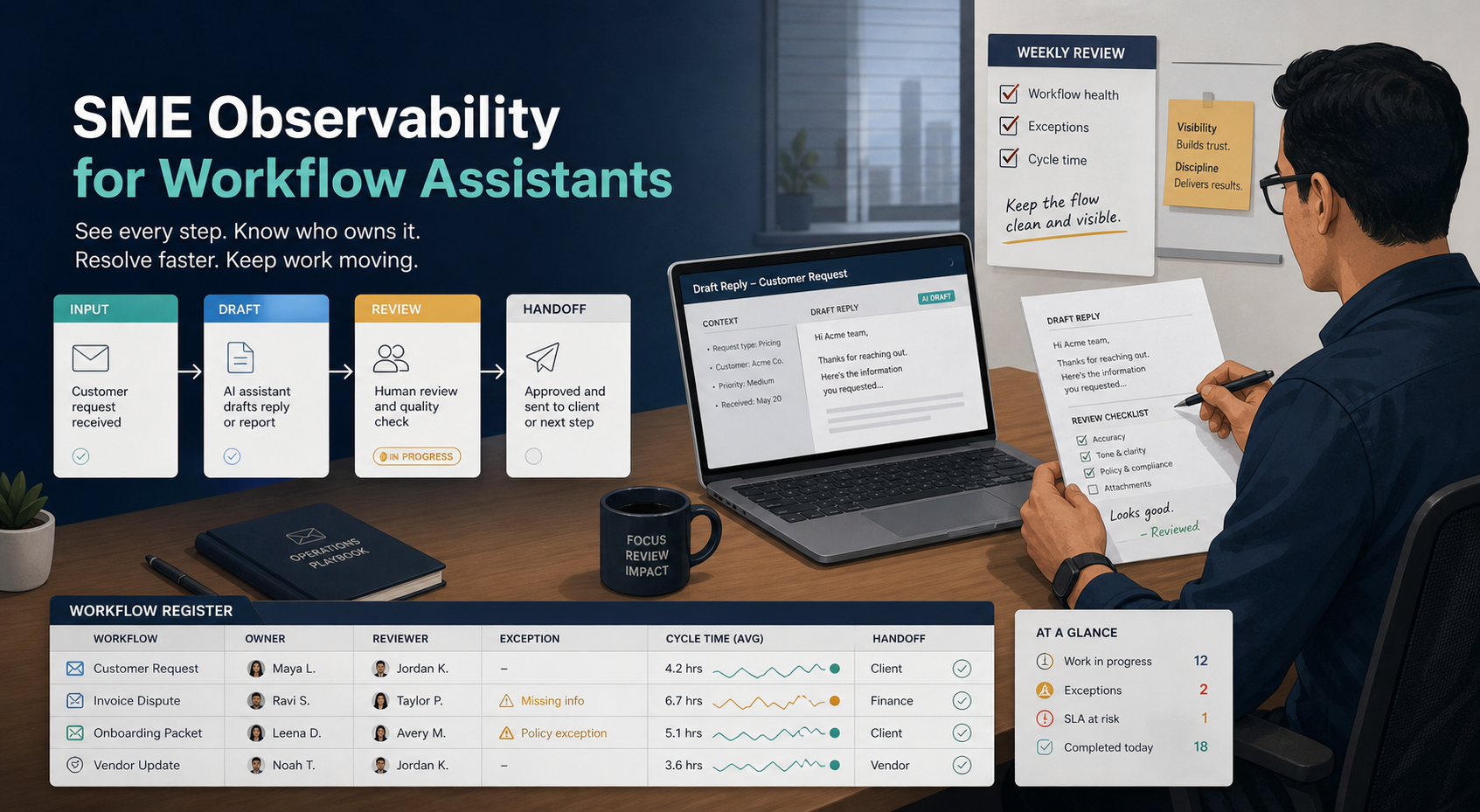
Can you audit the AI's work? A simple SME observability model for workflow assistants
AI assistants are moving out of the chat box and into the work itself.
Recent market signals make the direction clear: agents are spreading into devices, browsers and enterprise workflows, while governance, permissions and security are becoming the main blockers. That changes the question SMEs need to ask.
It is no longer just “can the AI produce something useful?”
It is “can we see what it did, measure whether it helped, and explain why we trusted the result?”
That is the real control problem.
If an assistant is drafting replies, preparing reports, routing tasks or assembling internal notes, the business needs more than a polished output. It needs observability. Without that, AI becomes hard to review, hard to improve, and hard to defend when something goes wrong.
Why this matters now
Most SMEs do not need more AI hype.
They need a way to manage the work AI touches without losing control of quality or accountability.
The risk is not usually that the assistant does nothing. The risk is that it does something, but nobody can tell:
- what it touched
- who approved it
- where it added value
- where it created rework
- where it quietly slowed the process down
That is why observability matters. If you cannot see the work, you cannot improve the work.
What observability means in practice
For an SME, observability is not a technical dashboard with a lot of noise.
It is a simple operating habit:
- trace the workflow
- record the handoff
- measure the exceptions
- review the weak points
In other words, make the assistant’s work reviewable.
That can be done with a spreadsheet, a ticketing system, a simple log, or a structured register. The tool matters less than the discipline.
The five signals that actually tell you something
If you want a useful SME model, track five signals:
1. Cycle time
How long does the workflow take from start to finish?
If AI is helping, cycle time should usually improve. If it does not, the assistant may be adding friction somewhere in the process.
2. Rework rate
How often does a human need to rewrite, correct, or rebuild the output?
This is one of the clearest signs of whether the assistant is genuinely helping or just producing extra admin.
3. Exception rate
How often does the workflow hit a case the assistant cannot handle cleanly?
If exceptions are common, the workflow is not ready for broad automation.
4. Approval delay
How long does it take for a human to review and approve the AI-assisted work?
If approval becomes the bottleneck, the team may have automated the wrong part of the process.
5. Handoff failures
How often does the work arrive at the next person without enough context?
That is where the hidden cost shows up. The AI may have done the first draft, but the human still has to start again.
These five signals are enough to tell you whether AI is reducing friction or hiding it.
A simple observability model for SMEs
You do not need a heavy governance programme to start.
You need a small, repeatable model.
Start with one workflow only. Pick something where AI is already being used, such as support replies, internal note drafting, proposal preparation, or routine reporting.
Then define four things:
- the input
- the output
- the reviewer
- the exception
That gives you a basic audit trail.
For example:
- the input is the customer query or source notes
- the output is the drafted response or report
- the reviewer is the team member responsible for approval
- the exception is anything that needed escalation, correction, or manual rebuild
Once that is in place, review the numbers weekly.
You are looking for patterns, not perfection:
- Is the assistant reducing time?
- Is the output stable enough to trust?
- Are the same exceptions repeating?
- Is the human reviewer doing too much cleanup?
That is the point where management stops being theoretical and becomes practical.
What this gives the business
This model does three useful things.
First, it exposes hidden labour.
If AI is saving time, you should see that in the numbers. If you do not, the labour has probably just moved elsewhere.
Second, it shows where AI is helping and where it is creating drag.
That matters because not every workflow should be automated in the same way. Some tasks are good for drafting. Some are good for routing. Some should stay human-led.
Third, it creates accountability.
When a workflow is reviewed, everyone can see what happened, where it failed, and who approved the result.
That is a much stronger position than “the assistant seemed fine at the time.”
Common mistakes
The same mistakes keep showing up.
Measuring usage instead of workflow health
How many prompts were sent is not the same thing as whether the business improved.
Tracking too many metrics
If the model is too complicated, nobody will use it.
Collecting data nobody reviews
A log that is never looked at is just storage.
Treating AI output as finished work
AI output still needs a control point. The business has to know when a human is responsible for the final answer.
Ignoring handoff quality
The biggest productivity loss is often not the draft itself. It is the extra cleanup the next person has to do.
If those mistakes are present, the AI programme is probably more optimistic than operational.
What SMEs should do this week
Do not start by instrumenting everything.
Pick one workflow and ask four questions:
- What is the exact start and finish of the workflow?
- Who reviews the AI-assisted output?
- What exceptions need logging?
- What would prove the assistant is actually helping?
Then create one simple weekly review.
If the data says the workflow is improving, keep going. If the data says the assistant is adding cleanup, fix the process before expanding it.
That is a more honest way to roll out AI than assuming the tool will sort itself out later.
Bottom line
SMEs do not need perfect AI.
They need visible work, visible exceptions, and visible ownership.
That is what observability gives you. It turns AI from a black box into a managed workflow.
And once the work is visible, the business can make better decisions about what to automate, what to review, and what to leave alone.
If you want help putting a simple AI observability model in place for your team, Seemee Technology Services can help you define the workflow, the signals, and the review rhythm before the process gets messy.
References
- Google Cloud, Startup technical guide: AI agents. Relevant as evidence that AI agents are moving into real operating workflows.
- Anthropic, Claude and Slack. Relevant as evidence that assistants are moving into working environments rather than staying in isolated chat.
- Box, Introducing Box agent security and governance: Deploy AI agents with confidence. Relevant as evidence that governance and access control are now central blockers for agentic AI.
Need help auditing AI-assisted workflows?
Seemee Technology Services can help you define the workflow, the signals and the review rhythm before the process gets messy.