The hidden AI supply chain risk SMEs are ignoring: plugins, SDKs and marketplace keys
The real AI risk for SMEs is no longer just model output. It is the plugins, SDKs, marketplace apps and keys attached to the system.
The hidden AI supply chain risk SMEs are ignoring: plugins, SDKs and marketplace keys
The AI risk most SMEs are still underestimating is not the model answer itself. It is the supply chain wrapped around the model.
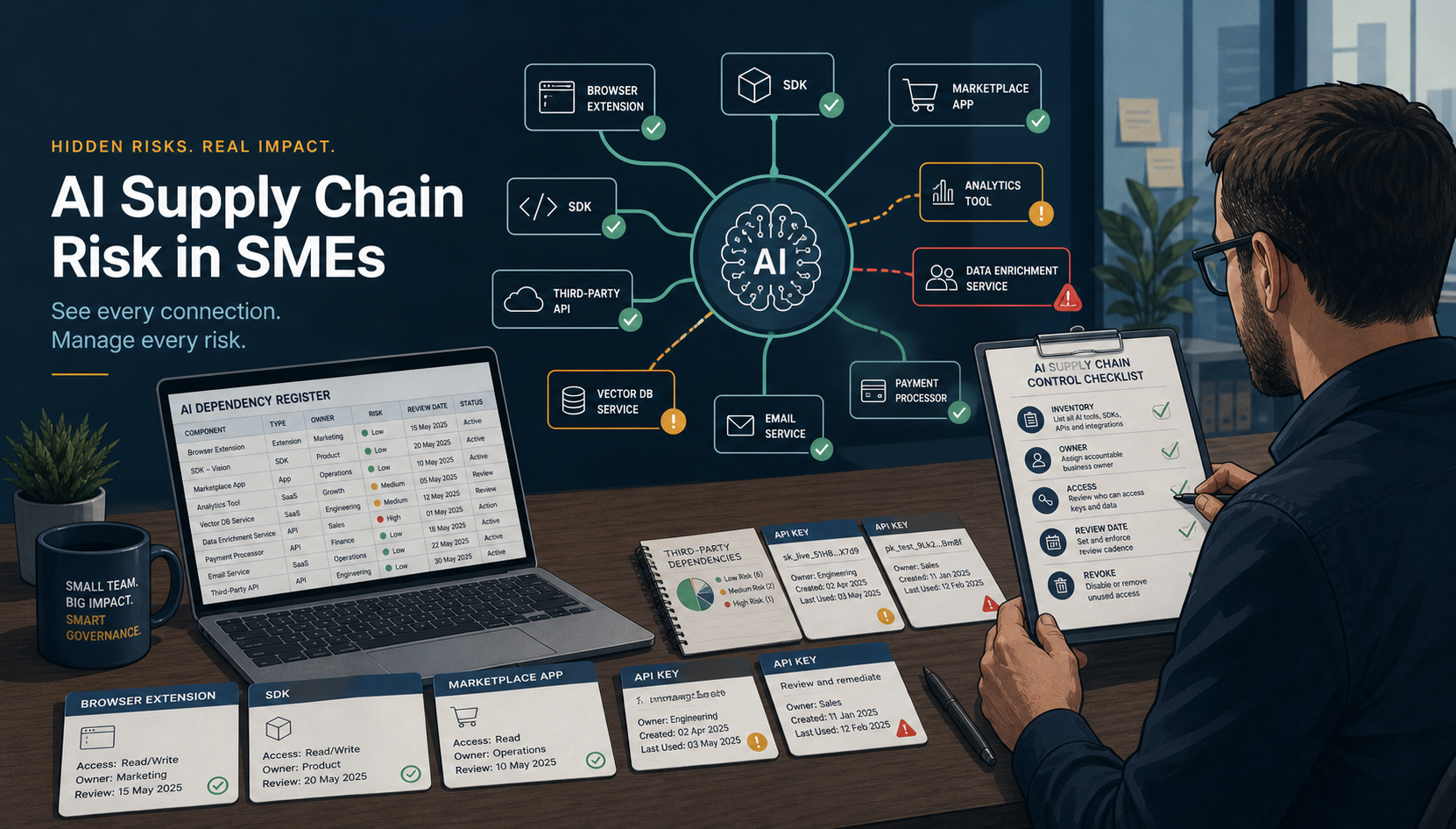
Plugins, SDKs, marketplace apps, browser extensions, service accounts and API keys can turn a simple AI pilot into a live business dependency in a matter of hours. That is fine when the setup is controlled. It is a problem when nobody knows who owns it, what it can access, or how to remove it.
For an SME, that creates three practical risks:
- third-party tools may see more data than intended
- access often survives after the pilot is forgotten
- hidden dependencies make incidents slower and more expensive to contain
This is not abstract cyber theory. It is basic operational discipline. If your business cannot inventory the AI add-ons attached to its tools, it cannot credibly say the AI stack is under control.
Why this matters now
Most AI adoption in SMEs does not start in IT. It starts with someone trying to save time.
A manager installs a plugin. A consultant connects a new connector. Someone adds a browser extension. A developer pastes an API key into a quick proof of concept. A marketing lead connects a content tool to the CRM. None of those choices feels strategic at the time.
The problem is that each one widens the business's exposure:
- the tool may inherit file, email or chat access
- the vendor may retain long-lived credentials
- a shared account may hide who approved the connection
- a marketplace app may become a permanent dependency without review
NIST's cybersecurity supply chain guidance has long treated third-party dependency visibility as a control issue, not a nice-to-have. CISA's software supply chain guidance says the same thing in plainer language: you need to know what you are using, where it came from, and how it is managed. OWASP's API security guidance goes one step further by warning that attackers often target integrated third-party services rather than the primary system itself.
That is exactly the pattern SMEs need to plan for with AI.
What counts as AI supply chain risk
In practice, the AI supply chain is anything that sits between the model and the business outcome.
That includes:
- plugins and marketplace apps
- SDKs embedded in internal tools
- browser extensions used for prompt work or automation
- API keys and service accounts
- file connectors, email connectors and CRM connectors
- workflow tools that call AI services on behalf of staff
- open source packages used in AI-enabled internal tools
The mistake is to treat these as harmless add-ons. They are not add-ons. They are access paths.
If a plugin can read documents, send messages or act in a workflow, it has operational authority. If a key is still active after the pilot ends, it has residual authority. If nobody knows where the dependency lives, it has invisible authority. Invisible authority is how small problems become hard incidents.
The control model SMEs actually need
SMEs do not need a giant governance programme to start. They need a practical control plane.
1. Inventory everything
Create one live register of every AI-related dependency:
- tool name
- vendor
- owner
- purpose
- data it can reach
- environment it runs in
- credentials or keys used
- date approved
- review date
If it is not in the register, it is not managed.
2. Separate pilot from production
Too many businesses run pilots with production access.
That is lazy, not fast.
Use distinct accounts, distinct keys and distinct permissions for:
- experimentation
- internal use
- customer-facing or operational use
If a tool only needs to generate a draft, do not give it document libraries, inbox access or admin rights.
3. Name both owners
Every dependency needs two owners:
- a business owner who understands the use case and risk
- a technical owner who can revoke access and investigate behaviour
No owner means no accountability. No accountability means no control.
4. Revoke what you do not use
Old pilots linger because nobody wants to touch them.
That is a mistake. In practice, the safest migration is often removal, not retention.
Look for:
- unused API keys
- stale service accounts
- old marketplace installs
- duplicate connectors
- test integrations that were never shut down
If a dependency has not been used recently and nobody can justify it, revoke it.
5. Review on a fixed cadence
Do not wait for a breach or a billing surprise.
Set a review rhythm:
- monthly for active AI tools
- quarterly for higher-risk integrations
- immediate review after staff changes, vendor changes or incidents
This is not bureaucracy. It is how you stop tool sprawl from becoming operational debt.
How to measure whether it is working
If this is real control, you should be able to track a few simple numbers:
- number of live AI dependencies on the register
- number of stale or unused keys revoked each month
- time needed to remove access when a tool is no longer approved
- percentage of active tools with named business and technical owners
- review completion rate for monthly or quarterly checks
Those metrics matter because they show whether governance is active or just documented.
The 30-minute audit any SME can run this week
If you want a quick starting point, do this:
- List every AI tool, plugin, connector, SDK and extension in use.
- Find every related API key, token and service account.
- Identify who approved each one.
- Mark anything with no named owner.
- Mark anything with more access than it needs.
- Revoke the oldest unused keys.
- Record the rest in a dependency register.
- Set the next review date now, not later.
That one audit will usually reveal three things:
- some tools are more deeply connected than staff realised
- several credentials are likely wider than necessary
- the business has no reliable exit plan for a few critical integrations
Those are useful discoveries. Better to find them before an incident does.
What good looks like
You are in a better position when you can answer these questions quickly:
- What AI dependencies are live?
- Who owns each one?
- What data can each one reach?
- Which ones are production critical?
- How fast can we disable any of them?
If the answers are unclear, the business is not controlling the AI stack. It is hoping for the best.
The commercial point
This is not just a cybersecurity issue. It is a control issue, a resilience issue and a cost issue.
Untracked AI dependencies create avoidable risk in four ways:
- data exposure
- unexpected spend
- process fragility
- vendor lock-in
That is why SMEs need a control-led approach, not a tool-led one. The companies that get this right will move faster because they know what can be trusted, what can be switched off, and what needs a proper review before it touches the business.
Bottom line
The hidden AI supply chain risk is not that AI is too powerful. It is that too many businesses are letting third-party tools, keys and connectors accumulate without ownership.
If you want AI to be useful rather than risky, treat every plugin, SDK, marketplace app and access key as part of the operating model.
That means inventory, ownership, least privilege, review and revocation.
That is the difference between controlled adoption and accidental exposure.
References
- NIST, Cybersecurity Supply Chain Risk Management programme and guidance: https://csrc.nist.gov/projects/cyber-supply-chain-risk-management
- NIST SP 800-161 Rev. 1, Cybersecurity Supply Chain Risk Management Practices for Systems and Organisations: https://nvlpubs.nist.gov/nistpubs/SpecialPublications/NIST.SP.800-161r1.pdf
- CISA, Software supply chain security guidance and SBOM resources: https://www.cisa.gov/topics/information-communications-technology-supply-chain-security/sbom
- CISA, Software acquisition and vendor response guidance: https://www.cisa.gov/software-acquisition-guide/tool
- OWASP, API Security Top 10 2023, especially unsafe consumption of APIs: https://owasp.org/API-Security/editions/2023/en/0x11-t10/
- OWASP, Secrets Management Cheat Sheet: https://cheatsheetseries.owasp.org/cheatsheets/Secrets_Management_Cheat_Sheet.html
CTA
If your team is adding AI tools faster than it can govern them, Seemee Technology Services can help you build a practical AI control plane: inventory, ownership, access hygiene and review cadence.
Need an AI control plane?
Seemee Technology Services can help you inventory AI dependencies, lock down access and set a practical review rhythm.