
Who owns the AI bill? A practical SME control model for tracking AI usage, approvals and spend
A practical SME guide to assigning ownership, setting approval thresholds and reviewing AI spend before it becomes invisible.
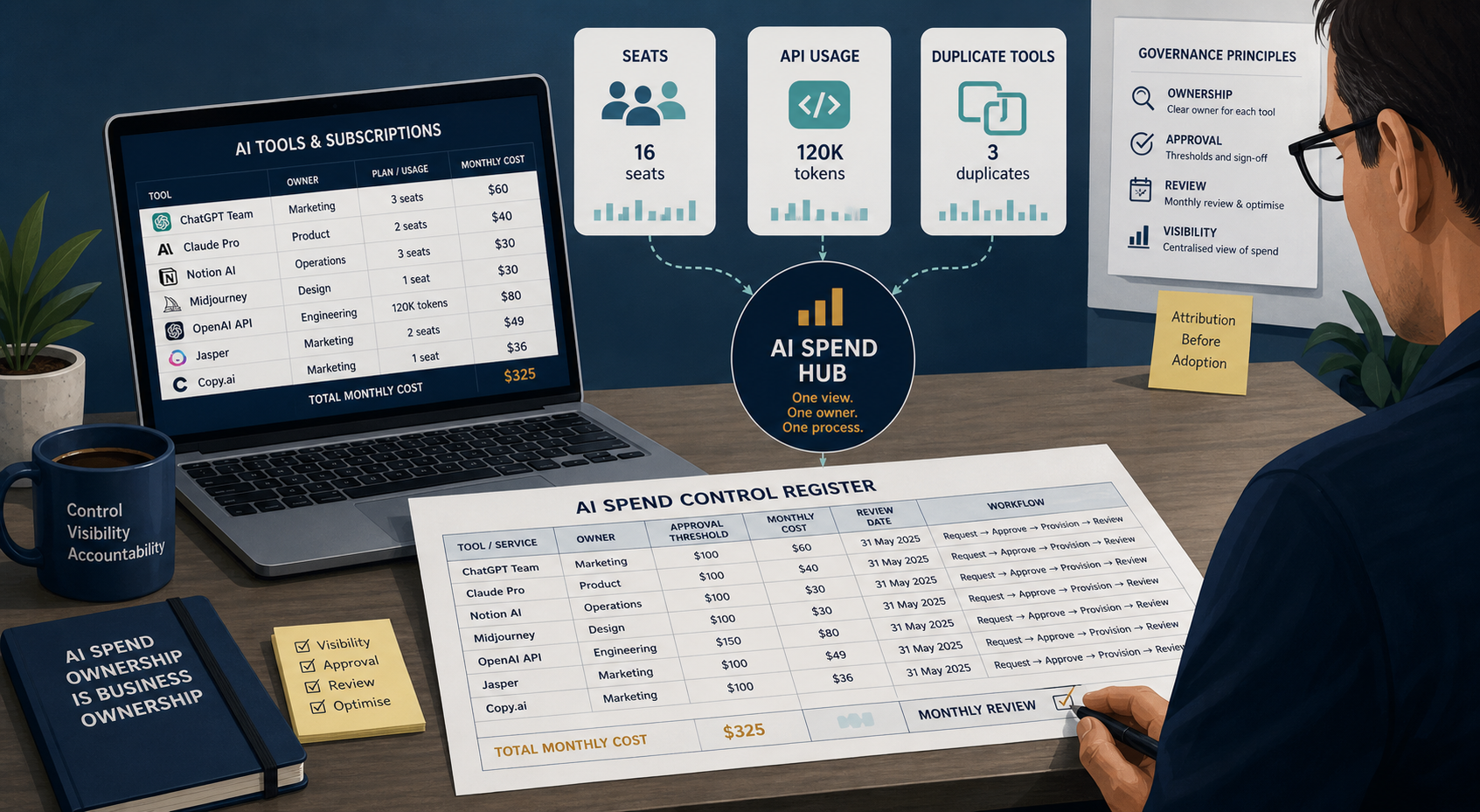
Who owns the AI bill? A practical SME control model for tracking AI usage, approvals and spend
AI spend rarely arrives with a dramatic announcement.
It starts as a few helpful seats, a pilot subscription, a model API trial, or a workflow tool someone on the team says is saving time. Then more people use it. Then another team buys something similar. Then the invoice appears, but no one is quite sure who approved it, who owns it, or whether the business is paying twice for the same job.
That is the problem.
For most SMEs, the question is no longer whether AI is useful. It is whether the business has a clear control model for who owns the bill, who approves the tools, and who reviews the spend before it becomes a permanent line item.
Why this matters now
AI is no longer a side experiment for many businesses. It is becoming part of day-to-day operations.
That changes the commercial question. A tool that starts as a convenience can quickly turn into an unmanaged cost centre if nobody keeps track of:
- seats and licences
- API usage
- overlapping tools
- hidden connectors
- approval history
- review dates
Recent signals from the market point in the same direction. Enterprise AI budgets are still growing, while governance products such as Okta for AI Agents and OneTrust AI Governance show that control is becoming a real buying category. That matters for SMEs too. The spending pressure is not just about more AI. It is about more AI everywhere, often without a proper owner.
If the business does not define ownership early, the stack fragments. One team pays for one tool, another team uses a different one for the same workflow, and finance only sees the issue when the monthly bill is already locked in.
The control model SMEs actually need
This does not need to be complicated.
Most SMEs need three basic controls.
1. One named owner
Every AI tool, subscription or workflow should have one business owner.
That person does not have to manage the technical detail, but they should be responsible for answering:
- why the tool exists
- which workflow it supports
- whether it is still worth paying for
- whether there is a duplicate or cheaper alternative
Without a named owner, nobody is accountable for the spend.
2. One approval threshold
Do not let every small purchase become an untracked experiment.
Set a simple threshold for what needs approval:
- new AI tools
- new seats
- new API usage
- new integrations
- any tool that can access company data or client data
The threshold can be financial, operational or risk-based. The point is that it should be clear enough for the team to use without arguing every time.
3. One review cadence
If no one reviews the stack, the stack grows without discipline.
Set a monthly review for active tools and a faster review for anything sensitive, client-facing or operationally critical.
That review should answer:
- what is live
- who owns it
- what it costs
- what it touches
- what can be removed
This is not bureaucracy. It is what stops AI spend becoming accidental spend.
What should be tracked
If you want to control the AI bill, you need a basic register.
At minimum, track:
- tool name
- vendor
- owner
- purpose
- workflow supported
- monthly cost
- API usage if relevant
- data access level
- approval date
- review date
- notes on duplication or replacement
The register does not need to be ornate. It just needs to exist and stay current.
The point is to make spend visible by workflow, not just by vendor invoice. A business can look efficient on paper and still be paying for three tools that all produce the same first draft or automate the same task.
The monthly review should ask hard questions
A proper review is not “is the tool still working?”
It is:
- does this still save enough time to justify the cost?
- is anyone else already paying for something similar?
- has usage increased faster than value?
- has the workflow changed enough to need a different setup?
- does the tool still need the access it has?
- can we remove it without hurting operations?
If those questions are not asked, the business is not controlling AI spend. It is just accepting invoices.
Common failure modes
The same mistakes keep showing up.
Nobody owns the stack
This is the most common failure.
If no one owns it, the business cannot explain it, reduce it or defend it.
Teams buy in isolation
Marketing, operations, sales and delivery all buy helpful tools separately, then the business discovers the overlap later.
That is how duplicate spend creeps in.
Spend is fragmented
Some tools sit on cards, some on departmental budgets, some inside larger SaaS platforms, and some are hidden in workflow usage.
Fragmented spend is hard to manage because no one sees the full picture.
Model cost is treated as the whole story
Token spend, seat costs and API usage matter, but they are not the full economics.
Admin time, review time, rework and duplication all change the real cost.
A practical SME checklist
Before approving or renewing any AI tool, ask:
- Who owns this?
- What exact workflow does it support?
- What is the approval threshold?
- What is the monthly cost?
- What data can it reach?
- Is anything else already doing this job?
- When is the next review?
If the answers are unclear, do not expand the spend. Clarify the control model first.
The commercial point
This is not mainly a technology problem. It is a commercial discipline problem.
An SME that cannot see its AI usage cannot properly manage:
- cost
- accountability
- duplication
- access risk
- review timing
That means the business is likely to overspend, under-review and over-approve.
The answer is not heavy governance. The answer is a simple operating rule:
- one owner
- one register
- one cadence
That is enough to keep AI spend visible and explainable.
Bottom line
The question “who owns the AI bill?” is really a control question.
If the business wants AI to stay useful, it needs to know who approves it, who reviews it, and who is responsible when the spend grows.
SMEs do not need a large governance programme to fix this.
They need a named owner, a clear threshold, and a monthly review that actually removes waste.
That is how you stop invisible AI spend before it becomes normal.
If you want help building a simple AI ownership and review model for your business, Seemee Technology Services can help you set the rules before the stack gets messy.
References
- Okta, Okta for AI Agents: https://www.okta.com/newsroom/press-releases/okta-for-ai-agents-core-brings-lifecycle-governance-to-regulated-environments/
- OneTrust, AI Governance: https://www.onetrust.com/products/ai-governance/
- NIST, AI Risk Management Framework: https://www.nist.gov/itl/ai-risk-management-framework
Need help building an AI ownership model?
Seemee Technology Services can help you set the rules for approvals, ownership and AI spend review.