
From AI Pilot to Operating Routine: Why Week 3 Breaks Most SME Rollouts
Week 1 of an AI pilot feels exciting. By week 3, quality slips, ownership blurs, and momentum fades.
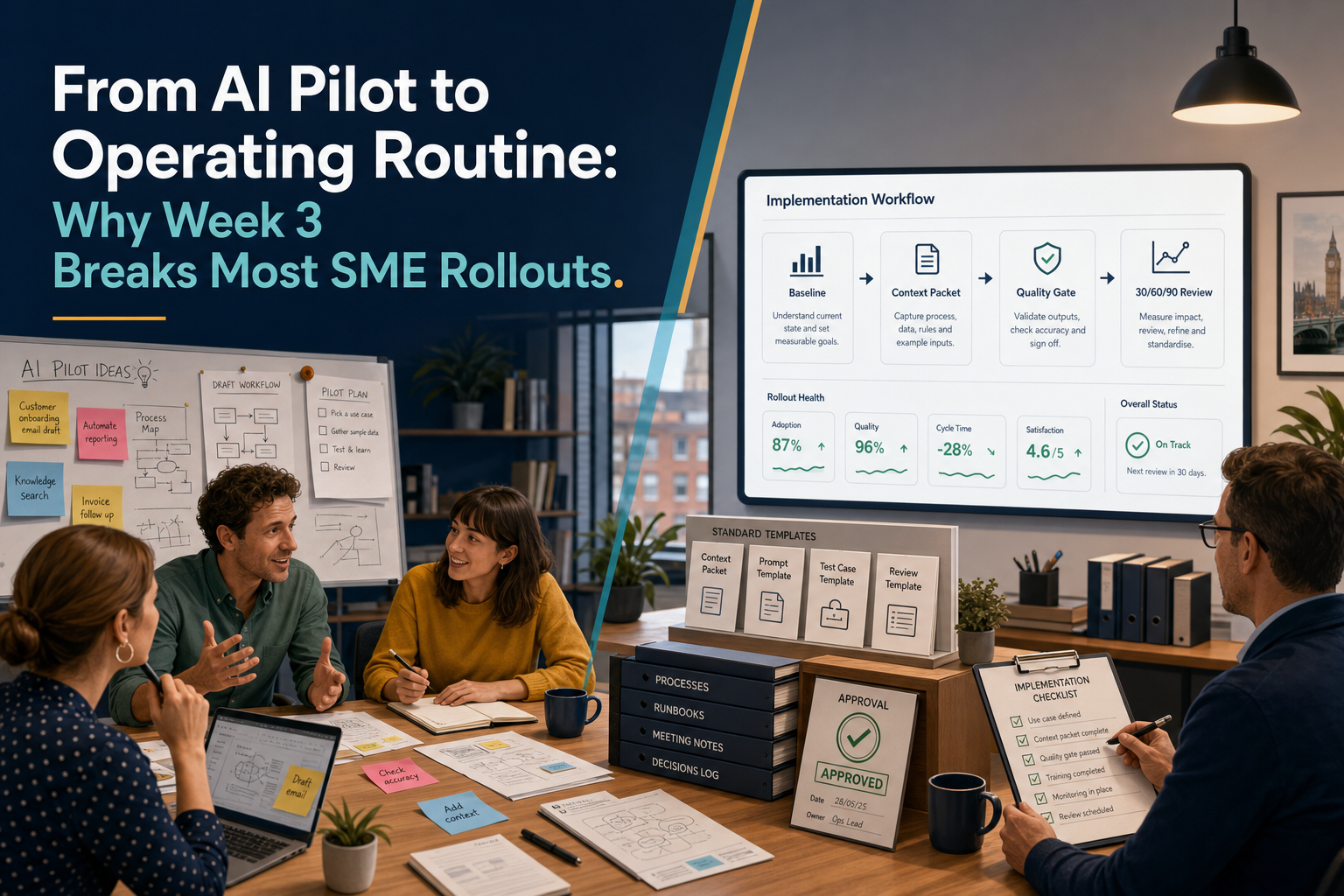
Week 1 of an AI pilot feels exciting. By week 3, quality slips, ownership blurs, and momentum fades. This guide shows SME leaders how to turn early AI wins into a repeatable operating routine with clear controls, measurable outcomes, and a practical 14-day implementation path.
Week 1 feels like progress. Week 3 reveals the truth.
In the first few days, AI usually looks impressive. Tasks move faster. Drafts appear quickly. Teams feel like they are finally breaking through backlog.
Then week 3 arrives.
Leaders start hearing familiar signals:
- “The output quality is inconsistent.”
- “Different people are using it in different ways.”
- “We saved time, but we also spent more time fixing mistakes.”
- “Can we prove ROI yet?”
This is where many pilots quietly stall.
Not because the model failed. Because the process never became operational.
Why most SME pilots stall
Most failed pilots share the same structural gaps:
- No single workflow owner accountable for outcomes
- No baseline metrics before rollout
- No standard context packet (inputs, constraints, expected format)
- No quality gate for customer-facing or financial outputs
- No continue/improve/stop decision cadence
Without these, AI becomes an ad hoc assistant rather than a managed business capability.
The shift that changes outcomes
Treat AI like an operating routine, not a tool experiment.
The SMEs getting repeatable value do five things consistently:
1) Start with one workflow, not ten
Choose one recurring workflow with clear business value. Examples:
- Weekly client reporting packs
- First-pass proposal drafting
- Customer query triage
2) Baseline before rollout
Track these three metrics on the manual process first:
- Cycle time
- Rework/error rate
- Weekly throughput
If you do not baseline, you cannot prove improvement.
3) Standardise the context packet
Every run should include:
- Task objective
- Source material
- Tone/format rules
- Compliance/commercial constraints
- Output template
This is the fastest way to reduce output drift.
4) Add a lightweight human quality gate
For external-facing, legal, financial, or sensitive outputs:
- factual check
- policy/compliance check
- commercial sanity check
The objective is safe speed, not blind automation.
5) Run 30/60/90-day decision reviews
At each checkpoint, choose one action:
- Continue as-is
- Improve and retest
- Stop and reallocate effort
Document updates in SOP v1 so value does not depend on one team member.
A practical 14-day rollout plan
Days 1-2
Pick one workflow. Assign owner. Capture baseline metrics.
Days 3-5
Define context packet and output template.
Days 6-8
Run supervised pilot with quality gate.
Days 9-11
Analyse rework patterns. Refine prompts, context, and review criteria.
Days 12-14
Make continue/improve/stop decision and lock SOP v1.
Example you can try this week
If you run a 20-person SME service team, test this on proposal drafting:
Workflow to pilot
“Create first draft proposal from discovery notes and pricing rules.”
Tool stack (simple)
- ChatGPT or Claude for first draft generation
- Google Docs or Notion template for output format
- Shared sheet for baseline + weekly metrics
Context packet template
Use this exact structure each run:
- Client type and objective
- Discovery notes (bullet points)
- Service scope constraints
- Commercial rules (discount limits, payment terms)
- Output format (sections, tone, length)
Quality gate checklist
Before sending externally:
- Is scope aligned to discovery notes?
- Are commercial terms compliant with policy?
- Is any claim unsupported?
- Is the recommendation commercially realistic?
This one workflow alone often surfaces where your AI process is strong and where governance is missing.
What good looks like after 30 days
You are on track if you can show:
- Faster turnaround with stable quality
- Lower avoidable rework
- Clear owner accountability
- Evidence-based decision on where to scale next
Bottom line
AI value in SMEs does not come from impressive demos. It comes from repeatable routines with ownership, controls, and measurable outcomes.
If your pilot is stalling, do not switch tools first. Fix the operating model first.
If you want a practical AI operating model for your team, Seemee Technology Services can help you design, test, and govern your first production-ready SME workflow.
References
- McKinsey & Company, The state of AI in 2025 (global adoption and scaling patterns): https://www.mckinsey.com/~/media/mckinsey/business%20functions/quantumblack/our%20insights/the%20state%20of%20ai/november%202025/the-state-of-ai-2025-agents-innovation_cmyk-v1.pdf
- BCG, Are You Generating Value from AI? The Widening Gap (AI value realisation and performance gap): https://www.bcg.com/publications/2025/are-you-generating-value-from-ai-the-widening-gap
- IBM Institute for Business Value, IBM Study: CEOs Double Down on AI While Navigating Enterprise Hurdles (CEO adoption and execution challenges): https://newsroom.ibm.com/2025-05-06-ibm-study-ceos-double-down-on-ai-while-navigating-enterprise-hurdles
- NIST, AI Risk Management Framework (AI RMF 1.0) (governance and risk controls): https://www.nist.gov/itl/ai-risk-management-framework
- OpenAI, Advancing voice intelligence with new models in the API (capability trend context): https://openai.com/index/advancing-voice-intelligence-with-new-models-in-the-api/
Turn AI pilots into operating routine
Use a 14-day implementation path with clear ownership, quality gates, and measurable outcomes.